Non-UKGC Licensed Casinos: UK Rules and Risks
 Available in GB
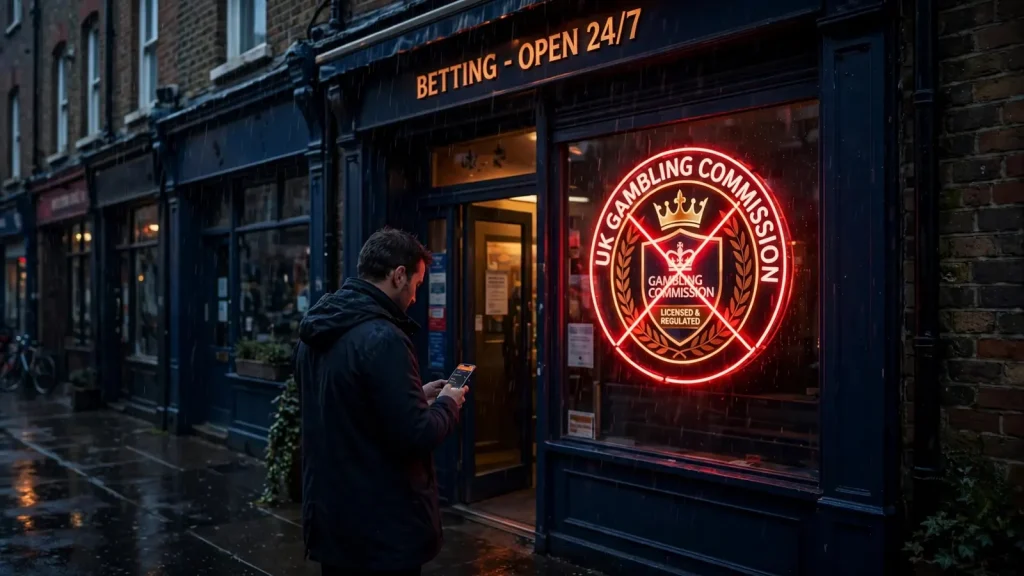
A practical guide to licensing claims, player protections, verification, withdrawals and payment terms at casinos outside UKGC regulation.
Table of Contents
- What a UK Gambling Commission Licence Means
- What Non-UK-Regulated Casinos Are
- What UK Law Says About Using an Overseas Casino
- How to Assess Claims About Non-UK Casinos
- GamStop, Self-Exclusion and the Limits of Protection
- What an Anjouan Licence Does—and Does Not—Provide
- How UKGC-Licensed Casinos Differ on Player Protection
- Withdrawal Delays, Limits and Verification Risks
- Payment Methods and Bonus Terms to Check
- How to Check an Overseas Casino’s Licence
What a UK Gambling Commission Licence Means
A UK Gambling Commission licence is the regulatory authorisation relevant to an operator serving customers in Great Britain. The important point is where the service is offered, not where the company has its headquarters. An operator cannot avoid the UK licensing requirement simply by being based overseas: if it serves customers in Great Britain, it needs a licence from the UK Gambling Commission (UKGC).
This makes the licence a useful starting point when you are trying to understand whether an online casino is part of the regulated British market. A site may use familiar branding, display games commonly found elsewhere, or describe itself as international. None of those details answers the central question. The relevant issue is whether the operator serving Great Britain holds the required UKGC licence.
What the licence tells you
The UKGC is the regulator named on the licence. Its involvement places the operator within the UK’s licensing framework for gambling services. That is different from a company merely having a British address, and it is different from a site being accessible from a British device. Location and availability do not, by themselves, establish that an operator is licensed to serve the market.
If you are considering a casino outside UKGC licensing, check its terms and the protections available to you before deciding. This list gives you a concise reference point on the information provided for each operator.
1. SlotoSport
Payout speed: 1-3 business days The listed payout speed for SlotoSport is 1–3 business days.
2. WinBeast
Payout speed: 1-3 business days The listed payout speed for WinBeast is 1–3 business days.
3. NightWin
Payout speed: 1-3 business days The listed payout speed for NightWin is 1–3 business days.
4. x3bet
Payout speed: 1-3 business days The listed payout speed for x3bet is 1–3 business days.
5. Jetsetspins
Payout speed: 1-3 business days The listed payout speed for Jetsetspins is 1–3 business days.
6. BeOnBet
Payout speed: 1-3 business days The listed payout speed for BeOnBet is 1–3 business days.
7. SpinFormula
Payout speed: 1-3 business days The listed payout speed for SpinFormula is 1–3 business days.
8. Chanze
Payout speed: 1-3 business days The listed payout speed for Chanze is 1–3 business days.
9. EvoSpin
Payout speed: 1-3 business days The listed payout speed for EvoSpin is 1–3 business days.
10. Amunbet
Payout speed: 1-3 business days The listed payout speed for Amunbet is 1–3 business days.
The term “UKGC-licensed online casino” therefore refers to more than a website that looks British or accepts customers who are in Britain. It describes a casino operation whose operator holds the relevant permission to serve customers in Great Britain. If you are comparing sites, keep the distinction clear: a brand name is not the regulator, and a casino’s location is not proof of its licensing status.
The licence requirement applies regardless of the operator’s base of operation. A business headquartered abroad is not exempt from the requirement if it serves customers in Great Britain. Equally, a company’s presence in Britain does not by itself tell you whether the online casino operation in question holds the relevant licence. The requirement follows the service being supplied to the market, rather than a simple test of the company’s postal address.
Why location alone can mislead
People often use phrases such as “UK casino” to mean different things: a site aimed at British customers, a company based in the UK, or an operator regulated in the UK. Those descriptions are not interchangeable. For licensing purposes, the key point is that operators serving customers in Great Britain need a UKGC licence, wherever they are based.
That distinction matters when a site presents itself as international or lists a licence from another jurisdiction. A foreign base does not remove the UKGC requirement for an operator serving Great Britain. Nor does the existence of a licence elsewhere establish that the operator holds a UKGC licence. These are separate questions, and a general claim that a casino is “licensed” does not answer both of them.
Non-UK-Regulated Casinos in the UK: Rules and Risks
If you are looking at a UKGC-licensed online casino, focus on the operator and the service, rather than relying on a logo or a broad description on a website. The words “licensed casino” are incomplete unless you know which authority issued the licence and which market it relates to. For this section, the defining point is straightforward: service to customers in Great Britain brings the UKGC licensing requirement, even when the operator is based outside the country.
A search for which online casinos are licensed by the UKGC is ultimately a question about the operator’s status, not just the casino’s name. A single brand can be presented in different ways across websites, while the business supplying the gambling service is what matters to the licensing requirement. Treat the brand as a label, not as proof of regulatory status.
This is also why the phrase “non-UKGC” needs careful interpretation. It means the operator is outside UKGC oversight; it does not describe where the company must be located. A non-UKGC casino may be based abroad, but its location alone is not the defining feature. The defining difference is whether the operator serving Great Britain holds a UK Gambling Commission licence.
When you encounter a casino described as UK-regulated, read that as a specific claim about its relationship with the UKGC. Do not infer it from the site’s appearance, its intended audience, or the country where the business is registered. A UKGC licence is tied to the operator’s authority to serve the British market, and the operator’s overseas base does not change that requirement.
Curacao Casino Licence UK: What Players Should Know
What Non-UK-Regulated Casinos Are
A non-UK-regulated casino is an online gambling site that operates without oversight from the UK Gambling Commission (UKGC). The term describes its relationship with the British regulator; it does not, by itself, say whether the site holds a licence elsewhere. Some sites may be licensed by another jurisdiction, while the label alone does not establish any licence status.
This distinguishes casino sites without a UKGC licence from UKGC-licensed casino sites. Both may offer casino games online, but only one category is overseen by the British regulator. “Non-UKGC” is therefore a description of the regulatory framework a site sits outside, not a guarantee about the quality, reliability or terms of any particular casino.
Licences from other jurisdictions
Non-UK-regulated casinos are typically licensed in jurisdictions such as Malta, Curaçao, Gibraltar or Anjouan. These names identify different licensing locations. A casino may refer to one of them when describing its licence, but that does not make the site UKGC-regulated. A foreign licence and a UKGC licence are separate things.
That distinction matters when you encounter a non UKGC casino site UK players can access online. The site’s location, the regulator named on its pages and the market it serves are not interchangeable details. A casino can be associated with a jurisdiction outside the UK while remaining outside UKGC oversight. The phrase “licensed casino” needs this context: ask which authority the operator means, rather than treating the word as a single, universal status.
Casinos Without a UK Licence: Rules for UK Players
The category includes a range of non UKGC casino websites, not one shared type of operator. Malta, Curaçao, Gibraltar and Anjouan are examples of places that may license such sites, but those names do not imply that every casino in the category is licensed by one of them. Nor does a site’s use of a jurisdiction’s name establish, on its own, what licence it holds.
What the label does not tell you
“Casino sites outside the UKGC” is a useful shorthand, but it should not be read as a full description of a site. It tells you that the UK Gambling Commission is not the regulator overseeing that casino. It does not tell you which games are offered, what terms apply, or whether a particular operator has a licence from another jurisdiction. Those are separate questions.
You may also see terms such as “non-UK-based online casino” or “casino site without a UKGC licence”. They point to related ideas, but they can be imprecise. A company’s base of operation is not necessarily the same thing as its licensing status. For this reason, “non-UK-regulated” is clearest when the subject is the absence of UKGC oversight, rather than the operator’s location.
The same care applies to a casino website that describes itself as international or refers to an overseas licence. Those descriptions do not turn it into a UKGC-licensed casino site. The meaningful distinction is whether the UKGC regulates it, not the wording used in its branding or the country named in a promotional message.
Malta
One of the jurisdictions where non-UK-regulated casinos may be licensed.
Curaçao
Another common licensing location for sites operating outside UKGC oversight.
Gibraltar
A jurisdiction that may license casinos not regulated by the UKGC.
Anjouan
A location providing licenses to operators that sit outside the British regulatory framework.
If you are comparing a casino outside UKGC oversight with a UKGC-regulated site, keep the labels precise. “Non-UKGC casino sites” groups together sites that share one defining feature: they are not overseen by the UK Gambling Commission. Their other characteristics may differ. A licence associated with Malta, Curaçao, Gibraltar or Anjouan identifies a possible separate regulatory connection; it does not erase the distinction between that connection and UKGC oversight.
In short, non-UK-regulated casinos are online gambling sites operating outside the UK Gambling Commission’s oversight, and they may instead be licensed in another jurisdiction. The category is defined by what it lacks in relation to the UKGC, not by a single overseas location or a uniform set of features. When you see “non-UKGC casino website”, read it as a regulatory description—not as a complete account of the operator.
What UK Law Says About Using an Overseas Casino
The legal position has two sides: the rules governing an operator that offers gambling to people in Great Britain, and the position of an individual who places a bet. They are not the same. A casino’s location or foreign licence does not, by itself, determine whether it may legally serve customers in the British market.
Under the Gambling Act 2005, operators supplying gambling services to people in Great Britain must hold a licence from the UK Gambling Commission. That requirement applies whether the company is based in Britain or elsewhere. A licence issued by another country does not replace the UKGC licence required for an operator serving this market.
Non-Gamban casino UK: what access really means
This is a rule directed at the business. If a non-UKGC casino takes customers in Great Britain without the required British licence, the operator is outside the local licensing framework. That does not automatically mean the person who opened an account or placed a bet has committed the same breach. The law distinguishes between supplying gambling services and using them.
What the law says about the player
UK law does not expressly make it an offence for a British citizen to use a gambling service licensed abroad. Nor does a player commit a criminal offence simply by gambling on a site that lacks a UKGC licence. Those points concern the player’s criminal liability; they do not give the casino permission to operate in Great Britain without the licence required of it.
The distinction matters because “not a criminal offence for the player” and “legally authorised to serve British customers” are different conclusions. The first describes the individual’s position under the law. The second concerns the operator’s duties. A non-UKGC casino may have a licence in another jurisdiction, but that does not make it a UK-licensed operator or bring its activity within the UKGC system.
It is therefore inaccurate to treat the absence of a player offence as proof that every non-UKGC casino is legally approved for use in Britain. Equally, it would be inaccurate to say that an individual automatically breaks criminal law merely by using a site without a British licence. Keeping those questions separate gives a clearer picture than treating “legal” as one answer covering both the company and its customer.
Legal Distinction
Using a non-UKGC casino is not a criminal offence for the player, but this does not mean the operator is legally authorised to serve the British market.
Citizenship is not the same as the operator’s market
A British passport does not change the operator rule. The key issue for licensing is whether the operator is supplying gambling services into Great Britain, not simply where its servers, owners or licence are based. An overseas company cannot rely on its foreign location alone to avoid the British licensing requirement if it is serving this market.
At the same time, the player’s nationality does not turn the operator’s licensing breach into a criminal offence by the player. The law’s focus on operators is why those statements can sit together: a casino may lack authority to serve Great Britain, while the person using it is not thereby committing a crime under UK law.
This explanation is about the general distinction in the law, not a ruling on a particular account, transaction or dispute. Individual circumstances can differ, and legal questions about a specific situation may need advice from a qualified professional. The central point remains that the operator’s obligation to hold a UKGC licence and the player’s exposure to criminal liability are separate issues.
So, when you encounter a non-UKGC casino, do not read “the player is not criminally liable” as “the operator is authorised in the UK.” A foreign licence and the player’s legal position answer different questions. The British licensing requirement applies to operators serving Great Britain, while the law does not make a player’s use of an unlicensed gambling site a criminal offence.
How to Assess Claims About Non-UK Casinos
A claim that a site is among the “best” non-UKGC casinos is not a reliable verdict on its own. Licensing labels tell you something about where an operator says it is regulated, but they do not establish that its offers are good value, that its rules suit you or that a particular claim will hold up when you try to withdraw. Treat rankings and labels such as “trusted” or “legit” as opinions to examine, not guarantees.
Safe Online Casinos in the UK: Licence and Checks
The practical question is what you would be agreeing to in return for an advertised benefit. A welcome offer can look generous while its conditions make the bonus difficult to turn into withdrawable winnings. A specialist review has reported offshore welcome offers with wagering requirements of 35x or more. The meaning of a 40x requirement can also differ: it may apply to the bonus alone, to the bonus and deposit together, or to a package involving bonus funds and free spins. Those figures are not a rule for every casino or every promotion. Read the terms for the specific offer, and check which funds must be wagered before you can withdraw.
Then compare that offer with the site’s rules for deposits and withdrawals. Non-UK-regulated casinos may set less restrictive policies, which can mean fewer limits and faster payouts. That possibility is not a promise that every transaction will be quick or straightforward, and it does not make a bonus worthwhile by itself. Consider the terms together: a flexible withdrawal policy may matter little if an offer has conditions you do not understand or would not be willing to meet.
Be wary of recommendations that present a single “top” choice as suitable for everyone. A new casino may attract attention because it is unfamiliar, but newness alone does not show that the operator will treat customers fairly. Likewise, a site described as trusted may still have terms that are a poor fit for your budget or expectations. Marketing language can make an offer sound simple; the rules determine what happens if you accept it.
Do
- Read the specific terms for every welcome offer
- Compare withdrawal policies across several sites
- Check which funds must be wagered before withdrawal
Don’t
- Rely on labels like “trusted” or “legit” as guarantees
- Assume a single “top” choice is suitable for everyone
- Base decisions solely on a bonus headline
Before deciding, ask yourself whether you would still use the casino if the promotion were removed. If the answer is no, the bonus may be doing more to shape your decision than the underlying terms justify. If you are comparing several sites, use the same questions for each one: what must you do to qualify, what conditions attach to the offer, and how much flexibility do the deposit and withdrawal rules actually provide? Do not assume that a method or policy mentioned in a promotion applies to every customer or every transaction.
There is no general recommendation that can be responsibly made from a licensing label or bonus headline alone. “Best” depends on the terms you are prepared to accept and the restrictions that matter to you. A careful comparison is more useful than a broad ranking: separate promotional claims from the operator’s rules, and decide whether the potential convenience is worth the conditions attached to it.
GamStop, Self-Exclusion and the Limits of Protection
GamStop is the UK Gambling Commission’s self-exclusion scheme. Casinos not on GamStop are outside it, so registering with the scheme does not include those sites in the self-exclusion arrangement. If you are looking for a “UKGC casino without GamStop”, treat that wording carefully: a casino outside the scheme should not be assumed to have UKGC oversight merely because a website describes it that way.
This matters if you have chosen to stop gambling. Self-exclusion is intended to help prevent access to participating gambling accounts; it is not a universal block on every gambling website. A non-UK-regulated casino may remain accessible even when you have registered with GamStop. Do not rely on your registration to prevent you from opening or using an account at a site outside the scheme.
VPN-Friendly Casino UK: Rules, Risks and Payments
The practical consequence is that you may not have the same required responsible-gambling tools available. Offshore casinos do not provide the mandatory tools that apply to UK-regulated operators. You should not assume that a site will offer effective ways to restrict your own access or gambling, or that a limit you set elsewhere will apply there. Check the site’s terms and tools before creating an account, but remember that checking does not make the site part of GamStop.
If you are using self-exclusion because gambling is causing harm, an account at a site beyond its reach can undermine the boundary you have set. It may help to avoid registering or depositing rather than relying on the scheme to block the site. If you have already self-excluded, consider whether searching for alternatives is working against the purpose of that decision. This is not a judgement; it is a practical gap in coverage worth recognising before you act.
There is also a difference between support and formal redress. Playing at an offshore casino means you forfeit access to the UK’s Financial Ombudsman Service and to mandatory responsible-gambling tools. That does not mean every form of help is unavailable, but it does mean you should not expect the same formal route for a complaint or the same required protections as at a UK-regulated casino. If a dispute arises, the Financial Ombudsman Service is not a route you can rely on for that offshore account.
Players at offshore casinos forfeit access to the UK’s Financial Ombudsman Service and mandatory responsible-gambling tools.
The phrase “not blocked by GamStop” can sound like a feature, but it describes the absence of the scheme’s coverage, not an added safeguard. A site may be accessible to someone who has self-excluded, while offering fewer required protections. Keep those points separate when assessing claims: GamStop participation concerns self-exclusion; the operator’s regulatory status determines which rules and formal protections apply. A badge or promotional claim alone should not settle either question.
If you are trying to maintain a break from gambling, treat access to sites outside GamStop as a real limitation of the scheme. The boundary may not extend to every casino, and the tools available at those sites may not match the mandatory protections in the UK-regulated market. Knowing that before you open an account can help you make a decision with clearer expectations.
What an Anjouan Licence Does—and Does Not—Provide
An Anjouan casino licence is not equivalent to the protections attached to a UK Gambling Commission licence. It sets a framework for the licensed operator, but it does not guarantee that your balance is kept separate from the company’s own money or that an independent body will resolve a dispute with you.
The distinction matters most if the operator runs into financial trouble. An Anjouan-licensed casino is not required to segregate player funds. If the company fails, you may therefore be an unsecured creditor rather than someone whose gambling balance has been ring-fenced. In practical terms, your claim could be treated alongside other debts, and repayment is not assured. A licence badge alone does not establish that money in your account is protected from the operator’s business risks.
Foreign Casinos for UK Players: What to Check
What happens when you complain
Under Anjouan’s framework, the operator must respond to a complaint within 30 calendar days. That is a requirement to respond, not a promise that the dispute will be settled in your favour, or even resolved by that deadline. Read the casino’s complaint procedure before depositing and keep copies of relevant messages, transaction records and the terms that applied to your account.
The Anjouan authority does not take up player complaints, mediate between a customer and a casino, or adjudicate disputes. An Anjouan-licensed operator also does not provide an independent dispute resolution route comparable to the approved alternative dispute resolution services available in the UK-regulated market. If the operator rejects your complaint or its response does not address the issue, there is no equivalent independent route under this framework for a player to ask to review the decision.
That leaves you relying heavily on the operator’s own process. A written response deadline can provide a point at which to follow up, but it should not be mistaken for external oversight of the outcome. Nor should a casino’s own statement that it has investigated a complaint be treated as independent adjudication.
What the licence cannot promise
For anyone reading non-UKGC casino reviews or comparing a non-UKGC regulated casino with a UKGC-regulated casino, the useful question is not simply whether a licence is displayed. Consider what the licence framework actually provides if your funds are at risk or you disagree with the operator. With Anjouan, the key limits are the absence of guaranteed segregation of player money, the authority’s lack of a role in individual complaints, and the lack of comparable independent dispute resolution.
Anjouan Licence Limits
An Anjouan licence does not guarantee the segregation of player funds or provide an independent dispute resolution route comparable to the UK market.
These limits do not prove that every licensed operator will mishandle funds or complaints. They do mean that the licence itself cannot be relied on to provide those protections. If a dispute arises, you should not assume that the UK Gambling Commission or a UK-approved dispute service can intervene on your behalf when the casino is not under their oversight.
Before using an Anjouan-licensed site, weigh the operator’s complaint procedure against the possibility that you may have to pursue the matter directly with the company. Be especially cautious about treating a response deadline as a guarantee of resolution, or an account balance as money held separately for you.
How UKGC-Licensed Casinos Differ on Player Protection
A UKGC-licensed casino operates under requirements intended to protect customers in Great Britain. A non-UK-regulated casino may be subject to a different framework, with less stringent rules for responsible gambling and data protection. That difference can affect what safeguards are available and how much oversight applies if something goes wrong.
At a UKGC casino, you can expect responsible-gambling measures to form part of the operator’s obligations, rather than being left entirely to its discretion. At a site outside the UKGC system, comparable measures may be less comprehensive or may not be offered in the same way. Do not assume that tools familiar from British sites will be present simply because a casino looks professional or uses similar language.
Non-GamStop European Casinos: UK Rules Explained
Data protection also deserves attention. A non-UK-regulated operator may follow standards that are less stringent than those applying to UKGC-licensed operators. Before sharing identity or payment information, read the site’s privacy terms: look for what information it collects, how it says it uses that information, and whether it explains how to contact the company about a concern. Clear wording is useful, but it does not by itself establish that the operator is subject to UK-level safeguards.
The practical difference is not just the badge beside a casino’s name. If you use a site outside the UKGC system, you do not have access to UK regulators when a dispute arises, and the protections you may expect from a UKGC casino cannot be assumed. A licence from another jurisdiction is not a substitute for UKGC oversight.
It is sensible to decide in advance what safeguards you need, rather than relying on a casino to provide them after you have deposited. If you depend on formal controls to manage gambling or want the protections associated with UK regulation, a non-UK-regulated casino may not meet those needs. No operator’s marketing can make that protection gap disappear.
Withdrawal Delays, Limits and Verification Risks
A withdrawal request does not guarantee that money will arrive promptly. Reports on non-UK-regulated casinos disagree: some describe payouts arriving within 24 hours to 5 business days, while others warn that a withdrawal can take three or four weeks. Treat both as possible reported outcomes, not a reliable timetable for a particular site. Without a regulatory clock to enforce a deadline, you may have limited leverage if processing stalls.
Potential Withdrawal Delays
Reported payout times vary significantly, with some arriving within 24 hours to 5 business days, while others may take three to four weeks.
The rules can also restrict how much you withdraw at once. A specialist review has reported daily, weekly or monthly withdrawal caps at some casinos, which could mean receiving a large win in instalments. Because this account is not a universal rule, check the casino’s current terms for any limits that apply to your account and whether they can change.
Verification can add further delay after you request payment. Some operators may ask for notarised documents or a video call before releasing funds. These steps can be onerous, particularly if the requirements appear only after you have won or if the operator keeps asking for more. Read the withdrawal and verification terms before depositing, and keep a copy of the version you relied on.
If a payment is delayed, save the request date, the casino’s stated reason and all correspondence. Ask the operator to identify the outstanding requirement and confirm the next step in writing. Do not assume that a site described as safe or trusted will process a withdrawal quickly: those labels do not establish how a dispute will be handled. UKGC-licensed real-money casinos operate under a different regulatory framework, while a non-UK-regulated casino gives you no UK regulator to enforce its withdrawal timetable.
Casinos & Safety: Licensing and Player Protection
Payment Methods and Bonus Terms to Check
A non-UK-regulated casino may offer deposits by credit card, e-wallet, bank transfer or cryptocurrency, sometimes using alternative payment processors. The method shown at the cashier is not necessarily available for withdrawals, so read the payment terms before depositing. Crypto also has a specific implication: it can bypass the UK ban on gambling funded by credit card. That does not make the transaction equivalent to a permitted card payment; check how the operator handles deposits and any rules attached to them.
Treat a bonus as a set of conditions, not as cash. Check what counts toward wagering, whether the requirement applies to the bonus, your deposit or both, and which games contribute. Some specialist reviews report offers with wagering requirements of 35 times or more, but terms vary and can change. Free spins may bring separate wagering conditions, withdrawal caps and short expiry windows; read the offer’s own rules for the exact conditions before opting in.
If the terms are unclear, or the offer depends on rules you cannot verify, declining it may be safer than risking a balance you expected to withdraw. A headline bonus says little about how much of any resulting winnings can actually be cashed out.
How to Check an Overseas Casino’s Licence
A licence badge on a casino’s website is a claim, not proof. To check online casino sites outside the UKGC, look up the operator on the issuing regulator’s own public register. Use the regulator’s official website rather than a link supplied by the casino, which could lead to an imitation page.
Compare the registered company name with the legal entity named in the casino’s terms and conditions. Check that the licence is shown as current and that the listed operator matches the site you intend to use. A licence belonging to a similarly named company does not establish that the casino itself is covered. If the register is unclear or the details do not match, do not treat the badge as confirmation.
This is different from checking for a UK Gambling Commission licence. For a UKGC check, search the Commission’s official register and confirm that the operator and relevant website are listed. A licence from another jurisdiction does not become a UKGC licence simply because it appears on a casino’s homepage.
In particular, an Anjouan licence does not authorise a casino to operate in the United Kingdom. A listing from Anjouan therefore cannot replace UKGC authorisation for serving customers in Britain. Before using any non UK regulated casino, you remain responsible for checking the laws that apply to you and understanding the implications of using a service licensed elsewhere.
Is it legal for a UK player to gamble at an Anjouan-licensed casino?
Yes, UK law does not explicitly prohibit you from using gambling services licensed in another country, and players do not commit a criminal offence by gambling on an unlicensed site. However, an Anjouan licence does not authorise the casino to operate in the UK; operators serving customers in Great Britain need a UKGC licence.
Can UK players legally play at casinos licensed in Anjouan?
Yes, UK law does not explicitly prohibit you from using gambling services licensed abroad. But an Anjouan licence does not permit the casino to serve the UK market, where operators serving customers in Great Britain require a UKGC licence.
Can I complain to the Anjouan regulator if a casino won’t pay me?
No. The Anjouan authority does not handle or decide player complaints; the operator must respond to complaints within 30 calendar days, but there is no independent dispute-resolution route comparable to UKGC-approved ADR.
Are Anjouan casinos connected to the GamStop self-exclusion scheme?
No. Casinos outside UKGC oversight are not part of GamStop, so you cannot rely on that scheme to block access to them.
What happens if I have a dispute with an Anjouan-licensed casino as a UK player?
You can complain to the operator, which must respond within 30 calendar days, but the Anjouan authority does not mediate or adjudicate player disputes. Anjouan-licensed casinos do not provide an independent dispute-resolution route comparable to UKGC-approved ADR.
Casinos

Anjouan Casino Licence for UK Players: What It Means
An Anjouan licence is separate from UKGC authorisation, so verification, terms and payment conditions need...

Best Casino App UK: App vs Browser Play
The way a casino opens on a phone can affect how quickly controls respond, even...

Foreign Casinos for UK Players: What to Check
The guide explains how offshore licensing, UK access, bonuses, payments and verification can affect player...

International Casinos for UK Players: What to Know
Explains how overseas licensing, bonus terms, payment choices and self-exclusion affect UK players considering casino...

Mobile casino deposits by phone credit in the UK
A guide to network-processed casino deposits, how they differ from card payments, and the checks...

Offshore Casino Sites for UK Players: Licensing Guide
Offshore status describes an operator’s position under UK rules, while licensing, payment terms and verification...

Offshore casinos for UK players: rules and risks
An overseas licence does not replace a UKGC licence, and the guide outlines the practical...

British casinos not on GamStop: what to know
The guide explains how UKGC licensing affects GamStop coverage, and what to check around self-exclusion,...

Casino no ID verification in the UK: what it means
The label may describe when checks appear, not whether age and identity verification can be...

Casino Sites Not Registered with GamStop: UK Rules
UKGC-licensed operators must participate in GamStop, while an overseas licence does not connect a casino...

Casinos Without a UK Licence: Rules for UK Players
A guide to overseas casino licensing, non-GamStop status, payments and the protections that do not...

Casinos That Bypass GamStop: A UK Guide
The guide explains which UKGC operators GamStop covers, how fixed exclusion periods work, and what...

Curacao Casino Licence UK: What Players Should Know
A Curacao licence belongs to a separate regulatory jurisdiction and does not mean an online...

Gibraltar Casino Licence and UK Rules
A Gibraltar location does not replace a UK Gambling Commission licence for operators serving Great...

Merkur Casino Online UK: Games, Login and Checks
Merkur-labelled games, casino accounts and operator services are distinct, so access, available slots and terms...

Trustworthy Online Casinos in the UK: What to Check
A practical framework for checking licensing, safer-gambling safeguards, terms and payment claims across UK-facing casinos....

No Account Casino UK: What to Check Before Playing
The label can describe a streamlined sign-up, but it does not remove a UKGC-licensed casino’s...

No-ID Verification Withdrawals at UK Casinos
A simple sign-up does not mean checks are waived: UK-licensed casinos must verify age and...

Non-Gamban casino UK: what access really means
A site Gamban does not block may still be covered by a separate self-exclusion agreement....

Non-GamStop Curaçao Casino Sites and UK Rules
A guide to how offshore licensing differs from UK rules, and what that means for...

Non-GamStop European Casinos: UK Rules Explained
European location alone does not establish a site's licence, safeguards or participation in the UK...

Non-UK Licence Casinos: Regulation Explained
Licensing jurisdiction, market access and player protections are separate issues when assessing an online casino....

Non-UK-Registered Casinos: Licensing and Risks
The term can refer to gambling operations outside UKGC oversight, but company registration and gambling...

Non-UK-Regulated Casinos in the UK: Rules and Risks
The guide explains the UKGC licensing requirement for operators serving Great Britain and the limits...

Malta MGA-Licensed Online Casinos and UK Rules
An MGA licence identifies a Malta regulator, but operators serving Great Britain need separate UKGC...

Online casino no registration in the UK: explained
Browser play, account setup and identity checks are separate issues, and each can affect whether...

Online Casino with No Sister Sites in the UK
Sister-site status can depend on shared ownership or core technology, not simply similar designs or...

Online Slots Not on GamStop: What the Label Means
The label refers to whether a casino joins the UK self-exclusion scheme, not to a...

Safe Online Casinos in the UK: Licence and Checks
A UK licence shows an operator is subject to regulator oversight, but it does not...

Casinos Not on GamStop UK: Risks and Checks
Learn how GamStop applies, what protections may differ, and which licence, bonus and withdrawal conditions...

Trusted UK Casino Checks: Licence, Terms and Records
A UKGC licence is the regulatory baseline, while site claims and payment options need separate...

USA Casinos for UK Players: Legal Status and Risks
The key distinction is whether the operator holds a UK Gambling Commission licence; an overseas...

VPN-Friendly Casino UK: Rules, Risks and Payments
A VPN may change how a casino sees your connection, but it does not guarantee...