Hi-Lo Casino UK: Rules, Bets and How to Play
 Available in GB
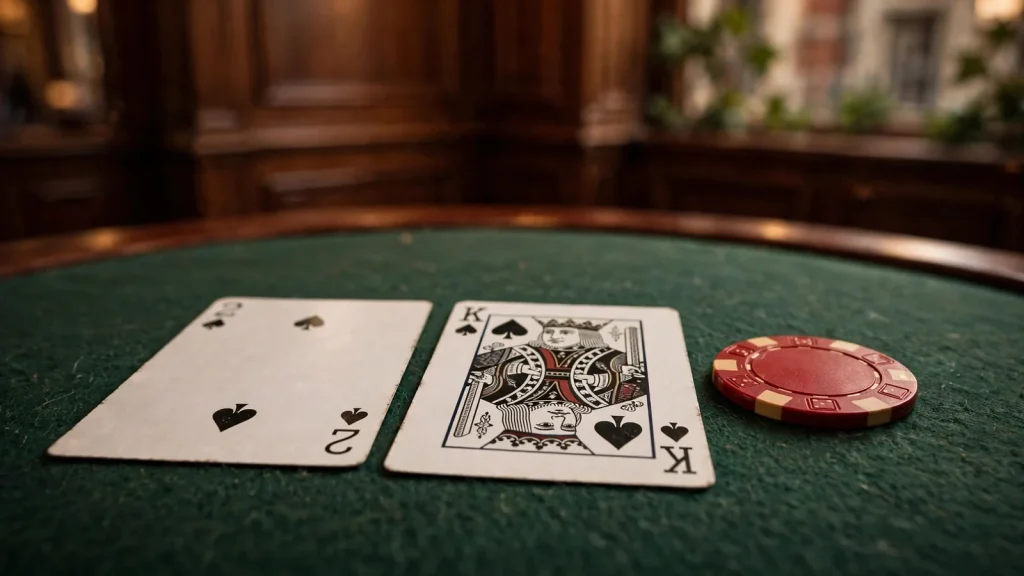
Hi-Lo compares each new card with the one showing, with choices and payouts varying across draw and live formats.
Table of Contents
- How Hi-Lo Works: Your Card Sets the Next Choice
- Playing Hi-Lo Online: Cards, Pots and Payouts
- How to Play a Draw Hi-Lo Round
- Draw Hi-Lo: Deck Rules and the Cost of a Wrong Guess
- Basic and Card-Counting Strategies in Draw Hi-Lo
- Live Hi-Lo: What Happens Between Card Decisions
- Live Hi-Lo Variants: Reels, Parlays and Return
- Choosing Between Higher, Lower and Proposition Bets
- Checking a Hi-Lo Casino Site in Great Britain
- Finding a Hi-Lo Casino Site That Fits Your Needs
How Hi-Lo Works: Your Card Sets the Next Choice
Hi-Lo is built around a comparison: you see a card, then decide whether the next one will rank higher or lower. The card in view is not simply part of the display; it sets the reference point for your choice. A low card leaves many possible ranks above it, while a high card leaves fewer. The decision changes as the reference card changes.
In a basic round, you make your prediction before the next card is revealed. Choose higher if you think the next card will rank above the one showing, or lower if you think it will rank below. Some versions also let you predict that the next card will have the same value. That option changes the choice available, but the central idea remains a comparison between the current card and the next one.
The exposed card matters because it gives you the information available at that moment. You are not choosing higher or lower in the abstract: you are judging the next card against a specific rank. If the reference is near one end of the card sequence, the two directions are not equally open in practical terms. Still, the choice is a prediction, not a way to control which card appears.
When choosing a UK hi-lo casino, payout timing can be one useful factor to consider. Use these short verdicts as a starting point and check whether each option suits your needs.
1. SlotoSport
Payout speed: 1-3 business days SlotoSport lists a payout speed of 1–3 business days. You can use that timing as one factor when considering it for hi-lo play.
2. WinBeast
Payout speed: 1-3 business days WinBeast lists a payout speed of 1–3 business days. You can take this timing into account when considering it for hi-lo play.
3. NightWin
Payout speed: 1-3 business days NightWin lists a payout speed of 1–3 business days. You can use that information as part of your hi-lo casino assessment.
4. x3bet
Payout speed: 1-3 business days x3bet lists a payout speed of 1–3 business days. You can factor this timing into your consideration of hi-lo options.
5. Jetsetspins
Payout speed: 1-3 business days Jetsetspins lists a payout speed of 1–3 business days. You can consider this timing when assessing it for hi-lo play.
6. BeOnBet
Payout speed: 1-3 business days BeOnBet lists a payout speed of 1–3 business days. You can use that detail as one point of reference for hi-lo casino play.
7. SpinFormula
Payout speed: 1-3 business days SpinFormula lists a payout speed of 1–3 business days. You can keep this timing in mind when considering it for hi-lo play.
8. Chanze
Payout speed: 1-3 business days Chanze lists a payout speed of 1–3 business days. You can take that timing into account as you assess hi-lo casino options.
9. EvoSpin
Payout speed: 1-3 business days EvoSpin lists a payout speed of 1–3 business days. You can use this as one factor when considering it for hi-lo play.
10. Amunbet
Payout speed: 1-3 business days Amunbet lists a payout speed of 1–3 business days. You can factor that information into your hi-lo casino assessment.
A new round may not begin with an entirely unrelated reference. In the described sequence, the winning card from the previous hand remains exposed and becomes the reference for the next round. So the card that has just appeared can shape the next decision. You look at that card, consider the direction you want to call, and make a fresh choice based on the new comparison.
This carry-over is easy to overlook when you first encounter a Hi-Lo casino game. The display may seem to present a series of separate guesses, but the visible card links one decision to the next. Pay attention to which card is currently setting the comparison, rather than relying on a previous choice or treating the screen as though it has reset.
The exact options and presentation can differ between versions. One may offer only higher and lower, while another may include a same-value choice. That does not change the basic question: how will the next card compare with the one currently exposed? Before you play, make sure you know which choices the version in front of you allows and what counts as a match for each one.
A wrong guess can void all winnings collected in that game, so the decision is not merely a way to keep a sequence moving. The reference card gives you a clear basis for understanding the choice, but it cannot make the outcome certain. Treat each prediction as a risk and keep track of the card that sets it.
JetX casino game in the UK: demo and review · Casino Dice Game UK: How Online Play Fits In
Playing Hi-Lo Online: Cards, Pots and Payouts
In an online Hi-Lo game, each decision centres on the value of the card currently shown. You predict whether the next card revealed will rank higher or lower. The sequence runs from an ace, valued at one point, through to a king at thirteen points. The suit does not change the point value described for the guess.
Your choice determines what happens to the money committed to that decision. If the next card matches the direction you selected, the guess is correct and the winnings are added to your pot. The pot is the running amount associated with your play, rather than a fixed prize paid for every successful choice. The amount credited depends on the game’s payout terms, so the card values alone do not tell you what a particular win is worth.
An incorrect prediction has a different consequence: the money placed on that guess is lost. In addition, a wrong guess voids winnings accumulated in that game, so the pot should not be treated as protected simply because earlier decisions went your way. A string of successful calls can increase the amount at stake in your play, but it does not remove the risk attached to the next reveal.
Descriptions of the online format differ on the deck setup. One describes a single 52-card deck with cards not returned after use; another describes six 48-card decks with continuous shuffling. Those are materially different arrangements, and you should not assume that one description applies to every Hi-Lo casino game. Check the rules displayed for the specific game before you play, particularly if the number of cards remaining or their return to play matters to your decision.
Loss of Winnings
An incorrect prediction voids all winnings accumulated in that game, meaning the entire pot is lost.
The key distinction is between the card result and the pot result. The card tells you whether your higher-or-lower call was right; the game’s payout terms determine how a correct call affects your balance. A displayed win is not a promise that the same amount will be credited in every version, and an incorrect call can erase the winnings collected during that game. Read the on-screen rules before staking money, and keep track of whether the amount shown is a current pot or a final payout.
How to Play a Draw Hi-Lo Round
A draw Hi-Lo round begins with a random card. Once it appears, decide whether to predict a higher or lower card for the next draw. If the choice seems close, take a moment to consider it rather than treating the decision as automatic.
After your first prediction, you can choose whether to continue or stop and collect the winnings accumulated so far. Continuing means making another higher-or-lower guess against the new reference card. Each decision therefore gives you a choice: bank what the round has built up, or put those winnings at risk by carrying on.
Before you make that next guess, check what the game says will happen if you are wrong. In this draw game, an incorrect guess voids all winnings collected during that game, so a growing total is not secured until you stop and collect it. A correct prediction may add to the amount available to collect, but it does not oblige you to keep playing.
Video Slots in the UK: How to Compare Games · Live Casino Lightning Roulette UK: What to Check
A simple way to follow the round is to pause after each revealed card. Check the current card, choose higher or lower, then reassess whether continuing is worth the risk. You do not need to decide how far to go before the first card appears: after the first decision, you can quit at any point and take the winnings accumulated up to then. If you continue, make the next choice with the possibility of losing the round’s collected winnings in mind.
Draw Hi-Lo: Deck Rules and the Cost of a Wrong Guess
Draw Hi-Lo uses one standard 52-card deck, with aces treated as the lowest cards. Once a card has been dealt, it is not put back. That changes the information available as a game continues: a card already seen cannot appear again in that same game, so the remaining deck is not a fresh, complete pack for every decision.
This no-replacement rule is specific to the draw format. It means the exposed cards matter not only as comparisons with the current card, but also because they have been removed from the pool of possible outcomes. The deck becomes progressively smaller as cards are used. That can affect how plausible a higher or lower result is, though it does not guarantee what the next card will be.
The game’s settlement distinguishes a correct call, a tie and an incorrect call. If your prediction is correct, the win is calculated according to the pay table. The card’s value alone does not tell you the amount you will receive; the table sets the applicable payout for the result. Check the rules displayed for the particular game before staking, since the pay table governs what a successful prediction returns.
Push Result
If the next card matches the current card’s value, the result is a push; the stake is returned rather than settled as a win or loss.
If the next card matches the current card’s value, the result is a push. It is not treated as a winning prediction or a losing one, and the stake is returned rather than settled as a win. A different result applies when your call is wrong: the bet loses, and any winnings already collected in that game are voided. Do not treat an earlier successful guess as protected from a later mistake.
These rules make it useful to keep the deck structure in mind when judging a Draw Hi-Lo game. The single pack and removal of dealt cards affect the sequence of possible cards, while the pay table determines the reward for a correct call. A tie leaves the wager unresolved; a wrong call ends its value, including accumulated winnings. That distinction is central to understanding the cost of continuing in this version.
Basic and Card-Counting Strategies in Draw Hi-Lo
A strategy figure can look more certain than it is. For the single-deck Draw Hi-Lo game described here, a specialist review reports a return of 96.07% when following basic strategy. The same review reports 100.36% for a card-counting strategy. These are figures attributed to that review and that game, not guaranteed results or returns that apply to every Hi-Lo game at an online casino.
The difference is worth understanding, but it should not be read as a promise that card counting will produce a profit. A return percentage describes an expected result across play under the assumptions used for the calculation; it does not predict what will happen in your session. Your result can be lower or higher, and a wrong guess voids all winnings collected in that game.
Best High-RTP Slots in the UK: Reading RTP Claims · Three-Reel Slots in the UK: Online Play Explained
What the two approaches mean
Basic strategy means choosing between higher and lower according to a consistent decision approach, rather than making guesses at random or following a hunch. It offers a reference point: the reported 96.07% return belongs to this approach in the described Draw Hi-Lo game. It is not a universal figure for online Hi-Lo, where the rules and pay table may differ.
Card counting uses information about cards already seen to inform later choices. In a game where used cards are not returned to the deck, the cards remaining can affect which outcomes are possible. Counting therefore calls for attention to the sequence of play, rather than treating every decision as though it starts from an unchanged deck. The reported 100.36% figure is attached to this strategy in the same specialist review; it should not be treated as a standard return across operators or formats.
Those percentages should also be kept separate from the game’s immediate result. A strategy does not change a losing guess into a win, and the reported return does not tell you how much you will collect before choosing to stop. It is a summary of expected performance, not a balance shown in your account or a promise of recovery after a loss.
How to use the comparison
If you are comparing the two approaches, first check that the game you are considering is the same kind of Draw Hi-Lo: a single deck, with cards not returned after use. A live game or another online version may work differently, so these strategy returns should not be carried across to it. The rules and pay table matter when interpreting any return figure.
Basic Strategy
Choosing higher or lower according to a consistent decision approach, resulting in a reported 96.07% return in the described game.
Card Counting
Using information about already seen cards to inform choices, resulting in a reported 100.36% return in the described game.
Basic strategy is the simpler benchmark. Card counting adds a need to track exposed cards and make decisions in light of what remains. The higher figure reported for counting does not establish that it is easy to apply, nor does it guarantee that a player will achieve that return. If keeping track makes decisions confusing, the headline percentage alone is not a sound reason to continue.
Treat both figures as information about one described draw game, not as a reason to increase a stake or chase a loss. Decide in advance what you are comfortable risking, and remember that a favourable theoretical return still allows losing results.
Live Hi-Lo: What Happens Between Card Decisions
The distinctive feature of this live Hi-Lo format is not only the higher-or-lower choice. It is what happens to the cards around each decision: cards are burned before a winning card is revealed, and cards from the previous round go back into a continuous shuffler. That is a different setup from a draw game in which cards remain out of a single deck after use. The distinction matters when you are trying to understand what the exposed card can tell you about what may come next.
A specialist review describes the live game as using six decks of 48 cards, with tens omitted. If a live casino presents the game differently, check its own rules rather than assuming that this deck arrangement applies.
Chicken Road Game Casinos in the UK: How to Check · Best 5-Reel Slots UK: How the Games Work
The reported deck composition is also worth reading precisely. Removing tens means the described decks do not contain that value; it does not mean the cards are simply a standard deck with an unspecified number of cards. Each deck in the account has 48 cards, and the stated reason is that tens are absent. This detail describes the particular reported setup. It should not be carried over automatically to every game that uses the Hi-Lo name.
The pause before a winning card
In the described format, three cards are burned before the next winning card is revealed. In card games, a burned card is taken out of the sequence without being used as the card on which the player’s decision is settled. For you, the practical point is that the card you are waiting to see is not simply the next card after the previous round’s winning card. Cards are removed from view first.
That changes how you should interpret the visible sequence. If you see a card used to settle a decision, you cannot assume the next winning card follows it directly. The three burned cards intervene before the next winning card is shown. Their values are not part of the visible decision, so you should not treat the sequence on screen as though every card in it were a result available to compare.
The burn procedure is a feature of the described live setup; it does not tell you what the burned cards were. Nor does it, by itself, provide a reliable way to predict the next revealed card. A player may be able to see a winning card, but the intervening burns mean that the visible record is not a complete account of the cards moving through the game.
Burn Cards
Three cards are burned before the next winning card is revealed, meaning the winning card does not immediately follow the previous one.
What continuous shuffling changes
The described game uses a continuous shuffler. Cards from the previous round are returned to it immediately, rather than being kept out of play for the rest of a longer sequence. That means the previous winning card is not necessarily absent from the pool of cards available for later rounds. The same card value can therefore appear again in play; the visible result from an earlier hand does not establish that it has been removed for the remainder of the game.
This is an important difference from a single-deck draw format where used cards are not returned. In that kind of game, the cards already dealt affect which cards remain in the deck. With continuous shuffling, the previous round’s cards are put back into the shuffler, so you should not apply the same running-card assumptions to the live game. A card seen earlier does not, on its own, tell you that the value is unavailable in a later round.
The combination of burning cards and continuous shuffling can make the sequence less transparent than a simple progression from one exposed card to the next. The winning card gives the reference for a decision, but the cards between rounds are not all presented as winning results, and the previous round’s cards are returned. Keep those mechanics separate when assessing what the visible history can and cannot tell you.
Check the rules for the specific table
The deck description and the shuffling procedure should be read as details of the reported live format, not as universal rules for every live Hi-Lo casino game. The same name can refer to games with different mechanics, so the rules displayed for the table you open are the relevant guide to its setup.
Plinko Casino UK: How to Check Games and Offers · Crash Casino Games in the UK: How They Work
Before playing, look for the explanation of the deck, the card-burning procedure and what happens to cards after a round. These are not cosmetic details: they determine whether previously seen cards remain out of circulation or return to play, and whether the next winning card follows immediately in the sequence. If the rules do not make those points clear, avoid filling the gaps with assumptions from another version of Hi-Lo. A live format may share the same basic higher-or-lower idea while handling the cards between decisions differently.
Live Hi-Lo Variants: Reels, Parlays and Return
Not every version labelled live Hi-Lo presents a card for each decision. A specialist review describes a reel-based format in which you choose Higher or Lower and one reel determines the result. That is a different mechanic from following a sequence of exposed cards, so check the game’s own rules before staking money. The review describes one particular version; it should not be taken as proof that every live Hi-Lo casino offers the same setup.
In that reel format, your selection is judged against the number where the reel stops. A result in the direction you chose wins; a result in the opposite direction loses. A tie also loses, rather than returning the stake as a push. That distinction matters: if the reel lands on the same value, you should not assume you can simply try again with the bet intact.
A losing guess voids all winnings collected in that game, as well as costing the bet at risk. The precise effect on a balance or any displayed running total depends on the game’s rules, so read those rules before starting. In particular, make sure you understand what happens to accumulated winnings if a later decision goes against you. A rising total on screen is not money safely collected until you choose to cash out, where that option is offered.
Do
- Collect winnings if you would be unhappy to lose them
- Check the stake and potential award before confirming
Don’t
- Rely on animated reels as evidence that a direction is due
- Assume a previous win makes the next result predictable
Parlay or collect
The specialist review says that after a win, the player can either parlay the original bet together with the winnings or collect and begin again. Collecting ends that run with the amount awarded at that point; a parlay keeps the accumulated value in play for another decision. The attraction of continuing is the possibility of a larger return, but the cost is that a subsequent loss can erase winnings from the game.
Treat the two choices as different ways of managing exposure, not as a system for improving the odds. A win does not make the next reel result predictable, and an earlier result cannot guarantee another win. If you would be unhappy to lose the winnings already on screen, collecting is the choice that avoids putting them through another guess. If you continue, do so knowing that the next outcome can take away the amount you have not yet collected.
Check whether the game shows the stake and potential award clearly before you confirm a further decision. Do not rely on an animated reel, a recent sequence of results or a rising total as evidence that a particular direction is due. The stated choice is simply Higher or Lower; what matters for your decision is the game’s displayed rule for how it settles a result, including a tie.
Reading the return figure
A specialist review gives 96.23% as the highest return for the game, specifically when betting Higher than 4 or Lower than 10. Those thresholds are part of the stated condition: the figure should not be detached from them or presented as the return for every choice, stake or live Hi-Lo game. It is an assessment tied to the described version, not a promise about what you will receive in an individual session.
Online Bingo in the UK: Games, Tickets and Slots · Crazy Time Live Casino Game in the UK
A return figure also does not mean that a particular run will pay back that share of your stake. Individual outcomes can differ, and a parlay exposes winnings to further loss before you collect. If a casino’s rules or displayed pay table do not match the conditions behind the quoted figure, do not assume the figure applies there. Use the game information on screen to confirm which variant you are playing and what its outcomes mean before you place a bet.
Choosing Between Higher, Lower and Proposition Bets
When you have a choice between Higher and Lower, compare what each option pays before placing a bet. The recommended approach is to select the direction with the larger payout, rather than assuming that one side is automatically preferable. The figures shown for the two choices are relevant to that decision: look at them together, then choose the better-paying direction for the exposed card.
That comparison is a way to make the available choice, not a promise that the bet will win. A higher payout does not remove the risk of a wrong guess, and the game’s displayed terms still matter. In particular, a Higher or Lower bet loses if the next card matches the exposed card. A tie is therefore not a neutral result for these bets. Keep that in mind when assessing the two payouts; neither direction covers every possible outcome.
Bet Verification
- Compare payouts for Higher and Lower bets
- For proposition bets, check if the winning condition requires the exposed card
- Confirm the bet’s winning condition and payout before committing
The exposed card is also important when you consider a proposition bet. Before choosing one, check whether its winning condition includes the card already showing. If it does, avoid that proposition: the exposed card is no longer in the shoe, so it cannot appear as the next card. A bet that depends on an unavailable outcome cannot succeed on that basis, however appealing its displayed payout may look.
This is a simple check, but it can change how a proposition should be read. Start with the exact condition needed for a win, then compare it with the card already exposed. Do not treat the face-up card as though it remains among the possible next cards. The choice should be based on outcomes that are still available, not on an outcome that has already been removed from consideration.
Higher and Lower bets call for a different comparison. You are choosing a direction relative to the current card, and the practical guidance is to favour the one that pays more. A proposition bet may have its own defined winning condition, so read that condition separately rather than assuming that the same comparison settles every type of wager. The exposed card check applies to propositions because it can rule out a stated winning outcome altogether.
A useful decision sequence is therefore to identify the type of bet first. If it is Higher or Lower, compare the displayed payouts and note that a matching card loses the bet. If it is a proposition, inspect the winning condition and rule out any outcome that requires the exposed card. These checks do not tell you what the next card will be; they help you avoid making a choice based on a payout or outcome that has been misunderstood.
High-Volatility Slots in the UK: How They Work
Do not compare options by payout alone when one of their conditions is impossible because the relevant card is already showing. Nor should a larger figure be taken to mean that a bet is safer. The payout and the condition for winning are separate parts of the decision. Read both before committing, and remember that a correct-looking choice can still lose when the next card does not meet its condition.
If the game presents the available choices clearly, take a moment to verify what each one means before selecting it. Check the direction or proposition, the stated payout, and whether the exposed card affects the outcome. That keeps the decision tied to the actual options on screen rather than to an assumption about how a Hi-Lo bet works. A careful comparison cannot remove uncertainty, but it can prevent avoidable errors in interpreting the bet.
Checking a Hi-Lo Casino Site in Great Britain
Before you deposit, check that the operator is authorised to provide gambling to customers in Great Britain. The UK Gambling Commission regulates commercial gambling here, including online casinos, and is the sole regulator for commercial gambling in Great Britain. Its oversight applies to remote gambling offered to people in Great Britain even when the operator’s equipment is located elsewhere.
A site’s claims about regulation are not enough on their own. Find the operator’s licence number and verify it on the UK Gambling Commission’s public register. Check that the licence is current and that it belongs to the business named on the site. The Commission issues operating licences to businesses and personal licences to individuals working in relevant roles; for a player, the operator’s authorisation is the key point. If you cannot confirm the licence on the register, do not treat the site as approved for Great Britain.
Regulatory Check
Verify the operator’s licence number on the UK Gambling Commission’s public register to ensure the site is authorised for Great Britain.
This check matters whether you are considering a Hi-Lo game or another casino product. Online gambling in the UK is legal for adults aged 18 or over when the operator holds the appropriate UK Gambling Commission licence. Operators must verify your age before allowing you to deposit, so a site that appears willing to take a deposit without completing age checks is a reason to stop and investigate.
Account protections to check before depositing
A UK-licensed remote operator must prompt new customers to set a financial limit before their first deposit and make account-level limit controls accessible. Look for these controls in the account area and make sure you can find them before funding the account. They are intended to help you set boundaries on your own spending; they do not make gambling risk-free.
Licensed casinos must also provide responsible-gambling tools, including self-exclusion. Check that the option is available and that the site explains how to activate it. If you think you may need to block your access across participating operators, GAMSTOP provides a UK self-exclusion service. Consider setting controls before play rather than waiting until you feel pressure to do so.
Payment rules offer another practical sign of the regulatory framework. UK-licensed casinos cannot accept credit cards for gambling, including credit-card funds routed through a money service business. They also cannot accept wallet payments where the wallet allows credit-card funds to be used for gambling. Do not assume that a payment method is permitted simply because it appears at checkout.
You should also be able to find the operator’s internal complaints process and information about access to an approved Alternative Dispute Resolution service. Keep the relevant terms and correspondence if you need to raise a concern. These protections apply to the operator’s regulated service; they are not a substitute for checking that the licence itself is valid.
Best RTP Casino Slots in the UK: How RTP Works
Finding a Hi-Lo Casino Site That Fits Your Needs
When comparing a Hi-Lo casino site in the UK, start with the operator rather than its promotions or presentation. A site offering real-money gambling to customers in Great Britain must hold the relevant UK Gambling Commission (UKGC) licence. Find the licence number in the site’s footer or account information, then check that it appears on the Commission’s public register and matches the business operating the casino. Do this before depositing; a logo or licence claim on a webpage is not a substitute for checking the register.
Next, look at the account controls you can actually use. Remote operators must prompt new customers to set a financial limit before their first deposit and make account-level limit controls accessible. Check where those settings are, whether you can review them easily, and how to activate self-exclusion if you need to stop gambling. Operators must verify your age before allowing a deposit, and gambling is for adults aged eighteen and over.
Live Blackjack Online Casinos in the UK: What to Check
Payment rules are another useful check. UK-licensed casinos cannot accept credit cards for gambling, including through a wallet that lets you use credit-card funds. If a payment option is unclear, check its funding method before relying on it.
Read the site’s complaints information before opening an account. A UKGC licensee must provide an internal complaints process and access to an approved Alternative Dispute Resolution service. Check that the operator explains how to raise a complaint and identifies the route available if you cannot resolve it directly. If those details are difficult to find, treat that as a reason to pause and verify them rather than assuming support will be straightforward.
You can compare sites on these practical points without relying on a ranking: a verifiable licence, clear limit and exclusion controls, transparent payment arrangements, and accessible complaint routes. Keep the register entry and the operator’s stated business details consistent. If they do not match, do not deposit until you have clarified who is responsible for the account. These checks help you assess whether a particular Hi-Lo casino site fits your needs while keeping the decision grounded in protections that apply in Great Britain.
Games

Aviator Casino Game UK: Licensing and Play
A guide to licensing, game classifications, access rules and casino offer terms surrounding Aviator play....

Three-Reel Slots in the UK: Online Play Explained
Three-reel games can resemble venue machines, but online play depends on the operator, account protections...

Best 5-Reel Slots UK: How the Games Work
See how reels, winning patterns, demo mode, bonus features and volatility shape the experience of...

Bonus-Buy Slots in the UK: Demo and Play Guide
Explore demo mode, slot rules, volatility and feature availability before deciding how to play. Trying...

Fast Payout Online Casinos UK: What Claims Mean
Keno prizes and paytables describe game outcomes, while cashout speed concerns withdrawal handling and cannot...

UK First-Deposit Casino Bonuses: Terms to Check
First-deposit offers can depend on eligibility, opt-in steps and qualifying payments, while headline terms do...

High-Volatility Slots in the UK: How They Work
High volatility describes a game's overall payout pattern, not a schedule or forecast for any...

Online Keno Casinos in the UK: What to Check
Keno games can differ in rules and payouts, so compare each version’s terms, features and...

Best Live Casino UK: Games, Rules and Offers
Understand how streamed tables, dealer decisions, game limits and offer conditions shape online live casino...

Low-Volatility Slots in the UK: What to Expect
Low volatility describes a pattern of smaller, more frequent returns, not a promise of steady...

Online Slot Payout Percentages: What They Mean
A slot’s stated return is an expected game figure, not a promise of what any...

Best RTP Casino Slots in the UK: How RTP Works
RTP describes a game's theoretical long-run returns, while variance helps explain why individual sessions can...

Best High-RTP Slots in the UK: Reading RTP Claims
RTP is a long-run statistical measure, not a promise about a particular spin, session or...

Video Slots in the UK: How to Compare Games
Five-reel layouts, game rules, bonus terms and demo play all affect how video slots work...

Casino Dice Game UK: How Online Play Fits In
Explore how online dice games relate to slots and casino sites, and what to consider...

Chicken Road Game Casinos in the UK: How to Check
A practical guide to distinguishing presentation from game mechanics and checking demos, versions, terms and...

Crash Casino Games in the UK: How They Work
Crash games are one format within online casinos, and their rules, stakes and outcomes depend...

Crazy Time Live Casino Game in the UK
Live casino play combines a real-time studio broadcast with betting controls, but each game's setup...

Deal or No Deal Casino UK: Slots and Game Rules
The show’s changing case values provide context for online slot bonuses, demo play and the...

Fastest Payout Online Casinos in the UK: Claim Limits
A speed claim cannot be compared without clear start and end points, calculation methods and...

French Roulette Online in UK Casinos: Rules & Odds
See how zero and La Partage affect even-money bets, and what to consider when comparing...

JetX casino game in the UK: demo and review
A practical guide to casino terminology, demo limits, bonus terms and checks before playing for...

Live Baccarat Online Casino UK: Tables and Bets
A practical guide to the live dealer format, baccarat bets, table checks and related casino...

Live Blackjack Online Casinos in the UK: What to Check
Understand how live tables work, what rules and stakes to expect, and which licensing and...

Live Casino Lightning Roulette UK: What to Check
Live play shows a dealer spinning a physical wheel, while digital roulette uses an RNG;...

Live Dream Catcher Casino UK: How Online Play Works
A practical overview of live table mechanics, casino checks, demo play, game rules and terms...

Live Roulette UK with English-Speaking Dealers
Live roulette pairs a studio dealer and physical wheel with on-screen betting, unlike roulette decided...

Mines Casino Game UK: Licensing, Demo and Terms
The guide separates UKGC-regulated access from offshore sites and outlines what to verify around demos,...

Monopoly Live Casino UK: Rules, Play and Site Checks
Explore the live-dealer format, roulette differences, game rules, site conditions, and the limits of statistics...

Online Bingo in the UK: Games, Tickets and Slots
A practical guide to ticket patterns, prize stages, promotions, slot access and setting limits across...

Online Casino American Roulette in the UK
A practical look at the table, wheel, betting options and what to check in a...

Online European Roulette UK: Rules and Odds
See how the single-zero wheel, bet payouts and online formats shape European roulette, and how...

Online Casino Games for Real Cash in the UK
A practical guide to slot stakes, casino deposits, withdrawal steps and the conditions that can...

Online Casino Tournaments in the UK: Free Entry
Tournament terms can distinguish a no-buy-in event from competitions requiring a ticket or payment, and...

Online Casino Without ID in the UK: What to Know
A delayed document request is not the same as avoiding identity verification altogether. What “Without...

Plinko Casino UK: How to Check Games and Offers
Plinko availability varies by casino, so check its game catalogue and understand licensing, play modes,...